One of my favorite parts about working in HR is also one of my biggest frustrations: people.
People are wonderful, complex, and unpredictable. You never quite know what to expect, and honestly, I love that challenge. But people can also be hard to wrangle, especially when you’re onboarding and trying to make sure everything is set up and running the way it should.
When Onboarding Becomes Its Own Full-Time Job
A few years ago, I worked as one of two HR employees at a 500-person company. It was in the oilfield construction industry, so the department structure was very consolidated. Even though HR was tiny relative to the number of people we supported, we were also responsible for marketing, advertising, recruiting, and more. We were stretched thin, and a lot of onboarding work that would normally be spread across multiple teams sat with us instead. That included ordering business cards, deploying email signatures, coordinating with IT on accounts and hardware, and plenty more.
As you can imagine, handling onboarding for 500 people with a two-person HR team was not exactly simple. We made lists upon lists of what needed to happen, when it needed to happen, and who needed to be looped in so nothing got missed. But even with all of that effort, frustratingly, things still slipped. Someone didn’t get their business cards on time; a new employee pasted their email signature into Outlook incorrectly; an IT ticket had to be submitted for something that felt far too small to need one in the first place.
Our checklists kept growing, but the process never got easier.
Our checklists kept growing, but the process never got easier. If anything, it got heavier. What started as an attempt to create order slowly turned into an increasingly complicated system to maintain. We were trying to save ourselves time, and we were trying to save IT time too, but instead, we were all spending more energy managing the process than the process was saving us.
I spent a year and a half with that company, and by the time I moved on, those checklists were pages long, with sub-checkboxes under sub-checkboxes. We were hiring often, and this should have been exciting; it should have felt like momentum. Instead, it was a headache, and onboarding was my personal nemesis.
So when I joined HiHello, I did what I had trained myself to do: I went straight into checklist mode.
The Day the Checklist Disappeared
I was once again on a very lean HR team, this time by myself, and I didn’t want to be caught unprepared - I wanted to be proactive. I started mentally mapping out every step, every dependency, every handoff. However, I quickly realized that my way of thinking and operating was outdated and that I had joined a company that had already solved the problem I was preparing to manage.
The setup itself was refreshingly simple. HiHello had already built an automated onboarding flow that handled the things that had eaten up so much of my time before: business cards, email signatures, virtual backgrounds, all triggered automatically when a new employee was added to the system. We turned on the directory integration with Google Workspace, connected our directory, and let it run. That sentence sounds almost too simple, but that was the beauty of it - there was no giant rollout, no tangled web of followups, no ongoing babysitting. No checklists! Just simple onboarding automation.
What "Set It and Forget It" Actually Feels Like
What I felt most, honestly, was relief. Palpable, overarching relief.
Relief at not needing a checklist for business cards.
Relief at not needing to think about email signature formatting.
Relief at not having to pull IT into the loop for every new hire.
Relief at knowing that brand consistency didn’t depend on whether someone remembered a step or pasted something correctly.
What had once taken up so much mental space just stopped being a thing I had to manage.
What had once taken up so much mental space for me, just stopped being a thing I had to manage (and when you work in HR, that matters). So much of my job is reactive by nature. There is always something urgent, something sensitive, something human that needs my attention. And the more time I spend managing administrative handoffs, the less time I have for the work that actually requires judgment, care, and presence. Getting that time back is not a small thing and really matters to me.
In practice, this new reality is exactly what I wish onboarding had looked like years ago at my previous company.
What HR Onboarding Automation Looks Like Now
A new hire joins our team, and I add them to our company directory and HRIS. Once that’s done, they automatically receive a digital business card, email signature, and virtual background. That’s it. No manual setup on my side. No IT ticket. No back and forth with Marketing. No wondering whether everything is up to date or on brand. And the same is true on the other end with offboarding. When someone leaves, their card pauses and the system handles it cleanly, without someone (i.e., me) needing to manually chase down loose ends. Simplified offboarding automation.
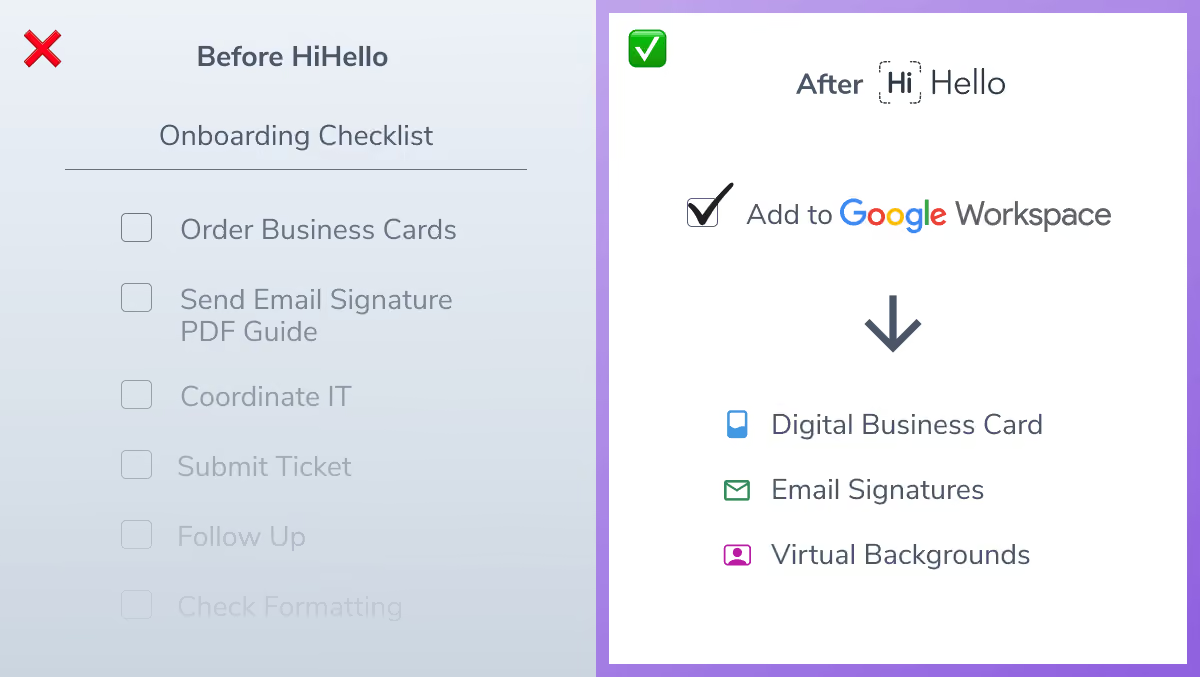
That may sound like a small operational improvement, but it’s far more than that. When onboarding infrastructure actually works, people feel it. I feel it. New hires show up looking like they belong from day one; brand standards stay intact without someone policing them; IT is not dragged into work that doesn’t need their attention; and I’m no longer the bottleneck holding together a string of manual tasks that should have been automated long ago.
What Modern People Ops Infrastructure Should Actually Look Like
To me, that is what modern People Ops infrastructure should look like. Not more checklists, not more coordination, not more invisible administrative work sitting on already stretched teams. Just systems that work the way they should: quietly, consistently, and at scale.
That is the real promise of “set it and forget it.” It is not about removing people from the process entirely, it’s about removing the kind of work that keeps People teams stuck in the weeds, so they can focus on the work only humans can do.