Every marketing team I know has a version of the same deck. Seventeen slides, CTR by channel, MQL velocity, a waterfall chart someone spent four hours building. I've helped build plenty of them, pulling the numbers, finding the story, trying to make something that answers leadership's questions and actually means something.
There's a thing every marketer eventually knows: answering the question isn't the same as asking the right one. We keep reporting what gets asked for, not because we believe every number tells a meaningful story, but because they survive budget meetings. And while we're heads down defending the dashboard, the most valuable channel in the company is running completely unmanaged.
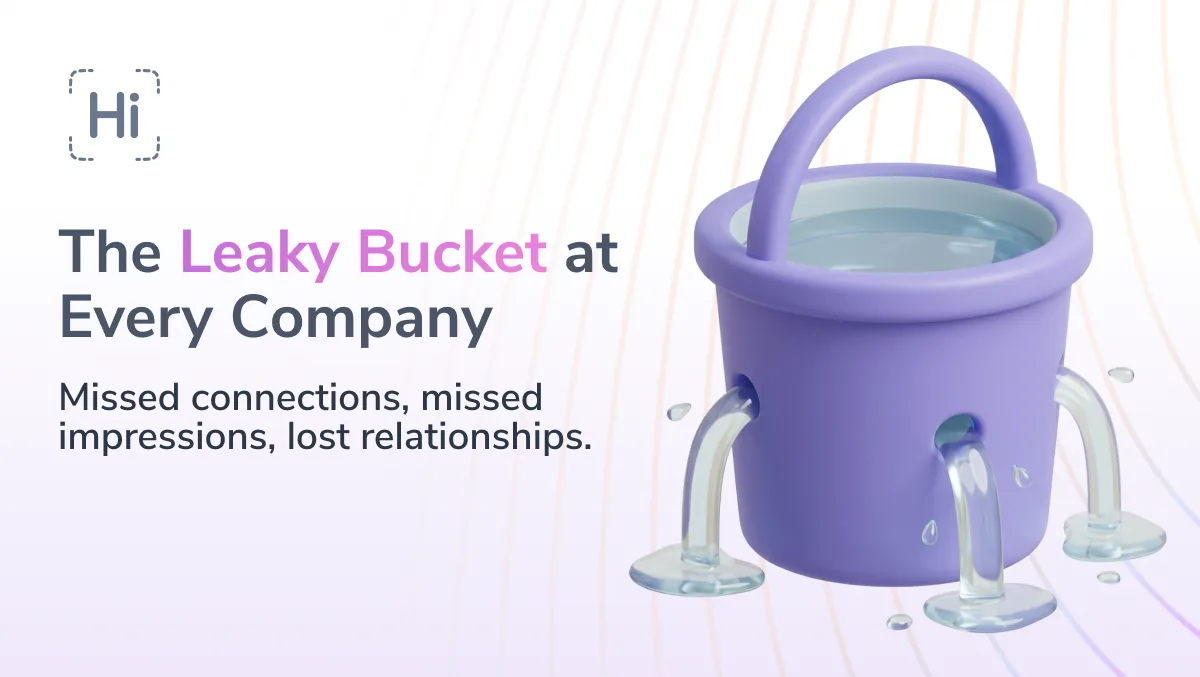
Think about what a company actually looks like to the market on any given day. Not the paid campaigns. Not the email sends. The real stuff: a sales rep following up after a trade show, a CEO chatting with a prospect at the hotel bar on the last night of a conference, a CS manager firing off a dozen emails before noon, a recruiter reaching out to a candidate who turns out to be a future buyer.
If it were just a few missed touchpoints, you could live with it. A hallway conversation here, a cold email there. Not everything is measurable. But that's not what we're talking about.
The Math Nobody Is Doing
Take a 200-person B2B company. Think about everyone who touches the outside world on any given day. Not just sales, but Customer Success, recruiting, finance, leadership, and marketing itself. Now think about how many meaningful interactions those people have with the market in a week. A follow-up email here, a sales call there, a coffee with a prospect, a conference badge scan, a candidate interview with someone who works at your top target account.
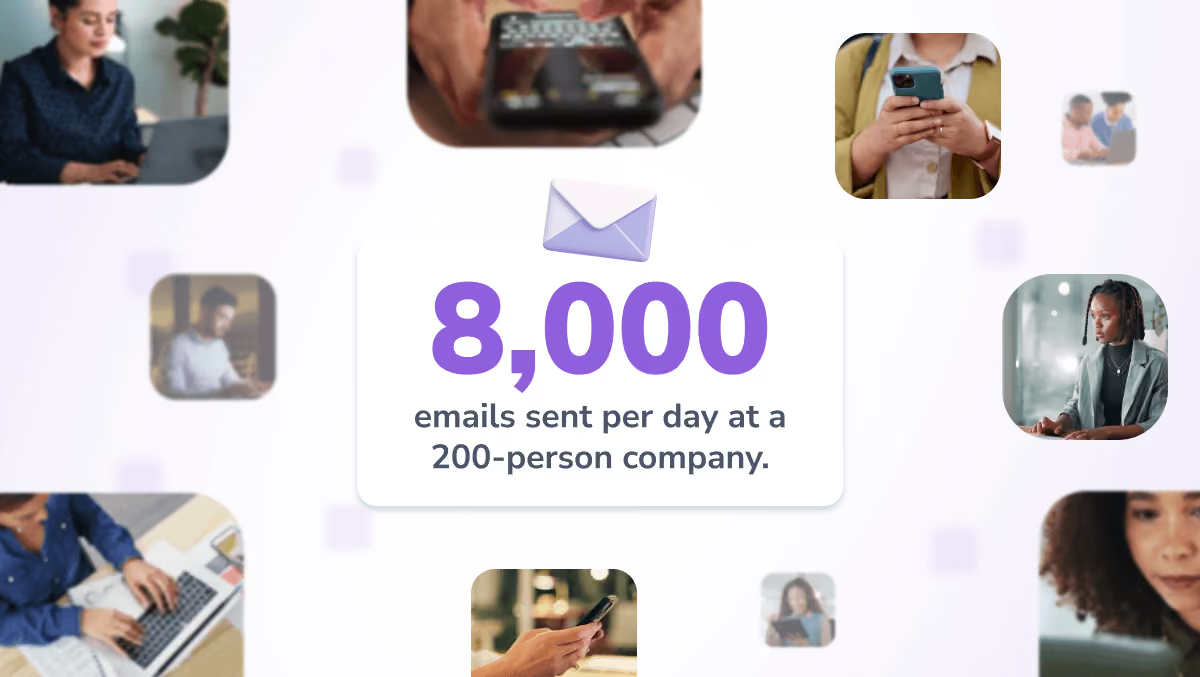
The average office worker sends 40 emails a day. For a 200-person company, that's 8,000 emails going out every single day, each one carrying a brand signal, a signature, a first or lasting impression. Close to 2 million a year. And that's before a single call, meeting, or event.
And every single one of those interactions is carrying something. A brand signal. A message. A credibility cue. The way your rep signs off their email, the event banner your Customer Success manager hasn't updated since last year, and the business card someone handed over at a trade show that had last year's logo on it. These are brand moments. They just aren't in anyone's dashboard.
Why This Happened
Nobody set out to ignore their most valuable channel. This isn't a story about marketers dropping the ball. It's a story about good marketers being rational people responding to a system that only rewards what it can see.
Attribution pressure is real. What gets measured gets funded. What gets funded gets attention. And what can't be cleanly tied to a conversion event gets quietly deprioritized until it falls off the roadmap entirely. That's not laziness. That's survival.
The problem is that the channels with the highest trust and conversion potential are the ones that are hardest to attribute. Word of mouth. A referral that started in an email chain. A buying decision quietly shaped by a conversation at a conference six months before anyone filled out a form. These don't show up cleanly on any platform. They live in what researchers call "dark social.” The vast, unmeasured space where real trust and influence actually happen.

And yet those are precisely the channels we've systematically underinvested in, because they're the hardest to defend in a budget meeting.
Introducing The Human Channel
So let's give it a name. The Human Channel is the aggregate of every employee-to-human interaction a company has with the market. Prospects, customers, partners, candidates, media, communities. All of it. The emails, the events, the LinkedIn activity, the follow-ups, the recruiting conversations, the executive keynotes, the signatures at the bottom of ten thousand emails sent this week alone.
It's not a new channel anyone has to build. It's already running. It has been since the day a company hired its first employee.
What makes it different from every other channel in the stack is three things. It's decentralized, meaning no single team owns it, and no single platform captures it. It's always on, meaning it's happening whether or not marketing is involved or even aware. And it's inherently high-trust because it's human, not algorithmic.
When it works well, it compounds. Employees who show up consistently and on message build category presence in ways that are slow to develop but nearly impossible for competitors to replicate. It shortens sales cycles. It earns referrals. It turns every person on the payroll into a distribution channel for the brand.
The data backs this up. According to Nielsen's Global Trust in Advertising Study, 88% of global consumers trust recommendations from people they know more than any other channel. More than paid search, social ads, or branded content. The Edelman Trust Barometer has found consistently that the employee voice is more credible than the CEO's. Decades of research point to the same conclusion: human, peer-driven communication is where trust is actually built.
Most companies have just never thought to treat it that way.
Where To Start
Here's what an unmanaged Human Channel actually looks like in practice.
Your AE's email signature still has the old logo on it. Your CS manager's LinkedIn headline lists a skill set that hasn't been relevant to their role in two years. Your SDR is sending follow-up emails with no consistent branding, no CTA, and contact information that goes to a Gmail account. Your recruiter is sharing content on LinkedIn that quietly contradicts the positioning your marketing team spent a quarter developing.
Nobody did any of this on purpose. That's the point.
The compounding effect is the part that's easy to underestimate. It's not one bad email signature or one outdated LinkedIn profile. It's the aggregate. It's what your brand looks like across 100,000 touchpoints a year when nobody is minding the channel.

Owning this channel starts with drawing your boundary wider. Most marketing teams define their scope by the campaigns they run and the content they produce. The Human Channel asks you to include every surface where your brand shows up in the hands of your people, and to give those people what they need to show up consistently.
These aren't glamorous or cutting-edge surfaces. But they're the ones that touch the market most often, with little to no oversight, and they leave a meaningful impact. Unified email signatures. Updated contact information. A professional identity that actually reflects the brand you've built.
That's the problem HiHello was built to solve, giving teams a way to standardize and activate the professional identity layer across an entire workforce, so that every handshake, every follow-up, every virtual call feels like it came from the same place. Less like a business card app, more like infrastructure.
The Metric That's Been There All Along
The dashboard isn't wrong. CTR matters. Pipeline velocity matters. MQL trends matter. These are real signals, and any marketer who says otherwise is oversimplifying.
But a dashboard that only shows half the picture isn't a dashboard. It's a blindfold.
The companies that win the next decade of B2B marketing aren't going to win because they found a better retargeting strategy. They're going to win because they figured out how to activate the human capital they already have: the people already talking to the market every single day, in every timezone, at every stage of the funnel, whether marketing is watching or not.
The Human Channel has always been the biggest channel. The interactions are already happening. The brand moments are already being made. The only question is whether to be intentional about them or keep leaving them off the dashboard.
What would your pipeline look like if your people were your best-performing channel?