We see a lot of companies up close at HiHello. For eight years, we've rolled out digital business cards, email signatures, and lead capture for thousands of companies across all industry segments, from insurance, legal, hospitality, construction, real estate, engineering, consulting, retail, automotive, technology, pharma, and more. In working with all of these companies, we've observed some common patterns that transcend industry and company size. Here are the three things that surprised us the most:
- Missed Connections. The connections your employees make don't always make it back to the company.
- Missed Impressions. The company brand often shows up inconsistently in the moments where people are paying the most attention.
- Lost Relationships. When employees leave, their relationships leave with them.
Missed Connections
Most companies try to capture the connections their employees create on behalf of the company, but few have a systematic approach to doing it. They spend inordinate amounts of money on having their human workforce go out to network at events, exhibit at and attend conferences, client dinners, travel, hotels, meals, all of that time, effort, and money, generally towards one singular objective: driving more leads for the company.
However, there is friction in this process. That friction comes from someone needing to exchange contact information, remember who they met, and then get that information into a system, often manually. No one wants to do that. Really. No one wants to do that.
Then there's the rented lead scanner, which stays at the booth while the best conversations often happen in the lunch line, at the dinner table, and at the airport on the way home.
Here's the hard part. When it takes effort to get a lead into your CRM, or into the inbox of someone who can act on it, you never know how many opportunities you're missing. And if leads aren't captured at the source, you can't answer the CFO when they ask about an event's ROI. You can't prove that the deal that made your quarter started at that event.
Think about this for your last big event. How many people did your team actually meet? How many of them aren't in your CRM today? How much opportunity is missing from your pipeline?
Missed Impressions
People costs are generally the biggest line item at most companies. Companies spend a lot of time, effort, and money on hiring, training, developing, and managing people. Companies also spend a lot of money on their brand and their perception in the market, whether it is a new logo, a new tag line, a subtle change in color, or a major repositioning.
Companies will spend millions of dollars on creating new assets, new videos, new case studies, and on trying to win awards and recognition. You can scream at the top of your lungs about these in paid campaigns, but that's like screaming into the void, because some of the people on the receiving end simply don't care. There's an old line in marketing, often credited to John Wanamaker: “Half the money I spend on advertising is wasted; the trouble is I don't know which half.”
Yet these two major investments, in people and in brand, rarely meet.
A company's brand is experienced through its people. Every interaction one of your people has, on every medium, is a surface where your brand should show up consistently.
But when the people in your company interact with a prospect, a customer, a client, a partner, a candidate, a vendor, or a supplier, every one of those people does care, and they are listening. That interaction becomes the perfect opportunity to make sure they see your newest award, your latest case study, or that you're going to the big industry conference. That shapes their perception of the company, and it affects their confidence and their willingness to do business with your people and your company.
Consider email alone. A 1,000-person company sends about 10 million emails a year. Each one is seen roughly five times as it is read, forwarded, and replied to, which adds up to 50 million potential impressions. Yet the signature under those emails drifts: an old logo, a broken copy/paste, someone's personal flair. And on video calls, the background is whatever happens to be behind the person, sometimes an unmade bed.
Lost Relationships
The relationships your people build for the company live in their personal phones, LinkedIn, and WhatsApp threads. On their phone, these are mixed in with their aunt, their brother, and their plumber. When someone leaves, those relationships and connections leave with them.
The loss is often invisible until it hurts. When a rep moves on, the CRM may still show the account and a primary contact, but rarely the people who shaped the deal: the champion who pushed it through, the engineer who vetted the product, the executive who signed. The account is still on the books, but the relationship behind it walked out the door. The next person starts with a cold call to a customer who already said yes.
Companies need to build their "house database" of all the relationships the people at the company form for the company, whether that lives in the CRM or somewhere else. Without one, a company's most valuable asset is on loan from its employees.
The Revenue Impact
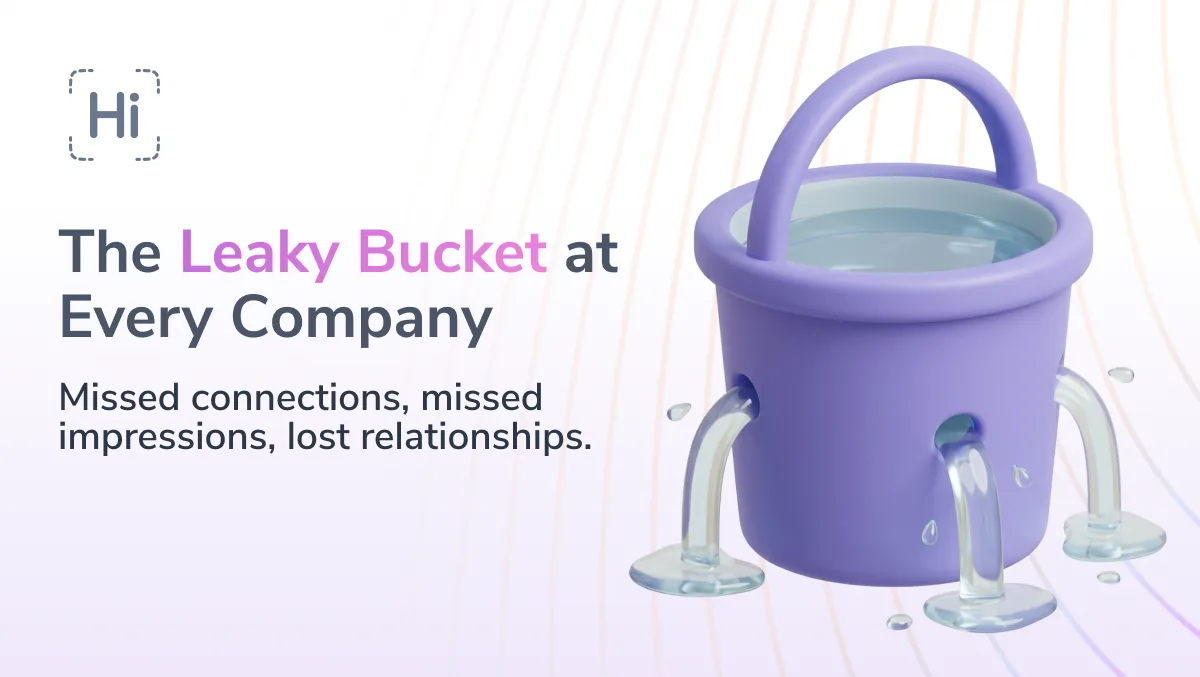
Together, the missed connections, the missed impressions, and the lost relationships all have an impact on one thing: the company's revenue. It's almost as if companies have forever been operating with a leaky bucket.
Each problem is its own leak. Missed Connections drain the pipeline before it starts. Missed Impressions drain the brand investment that should make every conversation easier and more impactful. Lost Relationships drain the customers and partners the company has already earned and invested in. In any single moment, the leak looks small, but when it is compounded across every employee, every event, and every email, all year long, it adds up to revenue the company paid for and never saw.
Why hasn't this been solved?
These human interactions are scattered all over the place: in lobbies, in booths, in email, and on video. They fall between marketing, sales, and IT. There has never been one system built to bring these human moments together and manage them at scale. It has been hard to do, and no one team owned it.
Why it matters more now?
AI is here. I use it every day. I've built agents that talk to my other agents. And the more of my work they take on, the clearer it becomes that the part they can't do is the part that matters most. In an age of AI where more and more business happens through agents, software, and screens, the human connection becomes more important, not less important.
The more AI absorbs the routine work, the more that human part is what separates the companies that matter from the ones that just generated a lot of content. When everyone has the same models and the same tools, the scarce thing isn't another agent. It's a real relationship with another person. AI doesn't make human connection matter less. It makes it the most valuable thing a business has.
Critical Infrastructure for the Human Channel
Just as every company starts out on either Microsoft or Google for setting up the identity and communication infrastructure for its people, it also needs a system to manage its people's professional presence and capture the value of the connections its people make. Together, those interactions form the company's Human Channel, and every marketing team can activate it. The system behind it becomes a critical layer on top of the identity layer.
That layer is what HiHello has grown into. For years, the market has known HiHello as a digital business card company. Cards are where we started, and they're still the part people see first. But the digital business card was always the tip of the iceberg. It opened the door to a bigger, more meaningful problem: how a company's people show up in every interaction, and whether the connections they make find their way back to the company. Few have approached that problem systematically, and almost no one has approached it from a marketer's point of view. That's the perspective we built HiHello around.
We've kept building around that problem, shaped by feedback from the thousands of companies we've worked with and supported as customers. HiHello is built for marketers, so marketing teams can take charge of the brand and the connections that lead to a direct impact on their pipeline and revenue. And it is secure and compliant, so IT can say yes with confidence.
Today, HiHello delivers that layer in two parts: Professional Presence for the whole company, and Lead Capture for the teams who meet customers.
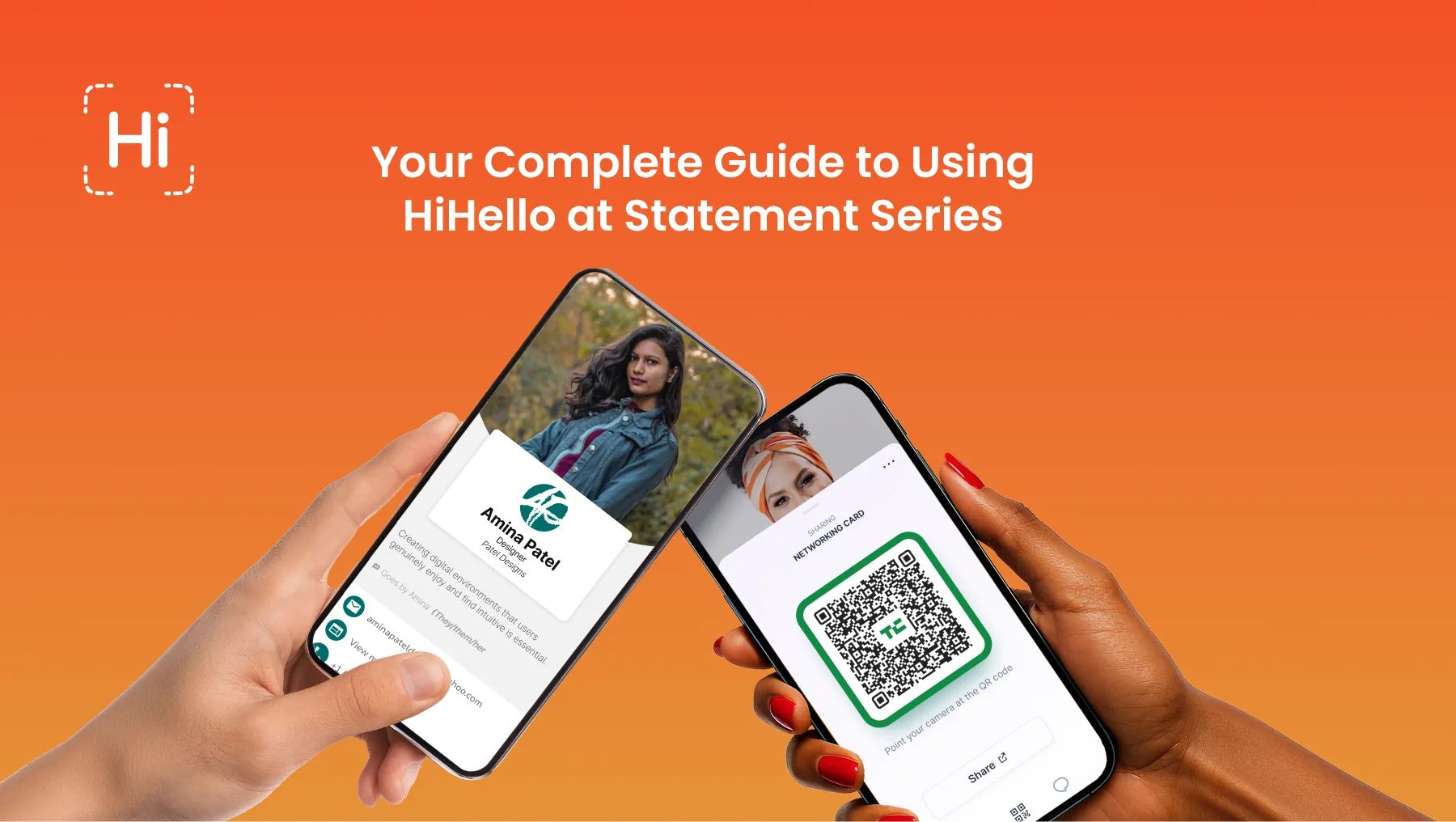
- Professional Presence connects your people with your brand. Every card, signature, virtual background, and email banner is current and on brand, and marketing manages all of it from one place.
- Lead Capture builds your house database. Anyone on the team scans a card or a badge from their phone, and the contact lands in your CRM while the conversation is still warm.
Here's what that looks like for our customers. Valpak Clipp's CMO, Mandy Febus, told us, “Since launching HiHello four months ago, we’ve already captured more than 9,000 leads and influenced over $540,000 in contract value.” Agents at Voluntary Insurance Partners have added nearly 2,000 prospects. At Martinus, email signatures generated 1.2 million views over the course of one campaign. And Goodwill uses HiHello’s email signature manager to protect their brand and the customers they serve so that people know an email "is really us."
Magic happens when humans connect
I have always believed that magic happens when humans connect.
Almost every meaningful thing that happens in the world happens because two humans connected. Every company that gets started, every hire that changes someone's career, every customer relationship that turns into something bigger, every breakthrough idea that builds on someone else's idea: it all comes down to humans connecting with other humans. The progress of humanity, in a real and unromantic sense, is built on that.
If you trace any meaningful thing in your own life backwards, it almost always lands on a connection. A friend introduced you to your job. A conversation at an event opened a door. A mentor saw something in you. A customer became a friend. A stranger became a co-founder.
That's the magic. And it doesn't always feel like magic when it's happening. Sometimes it feels like a 30-second exchange at a conference or a follow-up email three weeks later. But those small moments compound, and over time they shape entire careers and companies.
HiHello exists to amplify the power and possibility of human connection.
Today, we're launching HiHello as the Professional Presence and Lead Capture Platform. It's built to fix the leaky bucket, so your brand shows up consistently in every interaction your people have, and the value of every connection they make comes back to the company.