Email signature analytics measures the visibility and engagement of employee email signatures: from impressions when signature images load as recipients open emails to clicks on links, calls to action, and promotional banners. It turns email signatures from operational infrastructure into a measurable distribution channel.
For most enterprise marketing teams, employee email is the largest unmeasured channel they already own.
Marketing leaders are under growing pressure to demonstrate measurable business impact from every channel. At the same time, Gartner's 2026 CMO Spend Survey found that marketing budgets remain effectively flat, while organizations continue investing in new initiatives like AI. As marketers look for efficient ways to extend reach without increasing spend, they're taking a closer look at channels they already own but rarely measure.
Meanwhile, the average enterprise sends millions of employee emails every year to customers, prospects, partners, candidates, and vendors. Every one of those emails could carry an email signature. Until now, almost none of that reach has been measurable.
That's the opportunity inside email signature analytics.
Why employee email is the channel CMOs already own (but can't see)
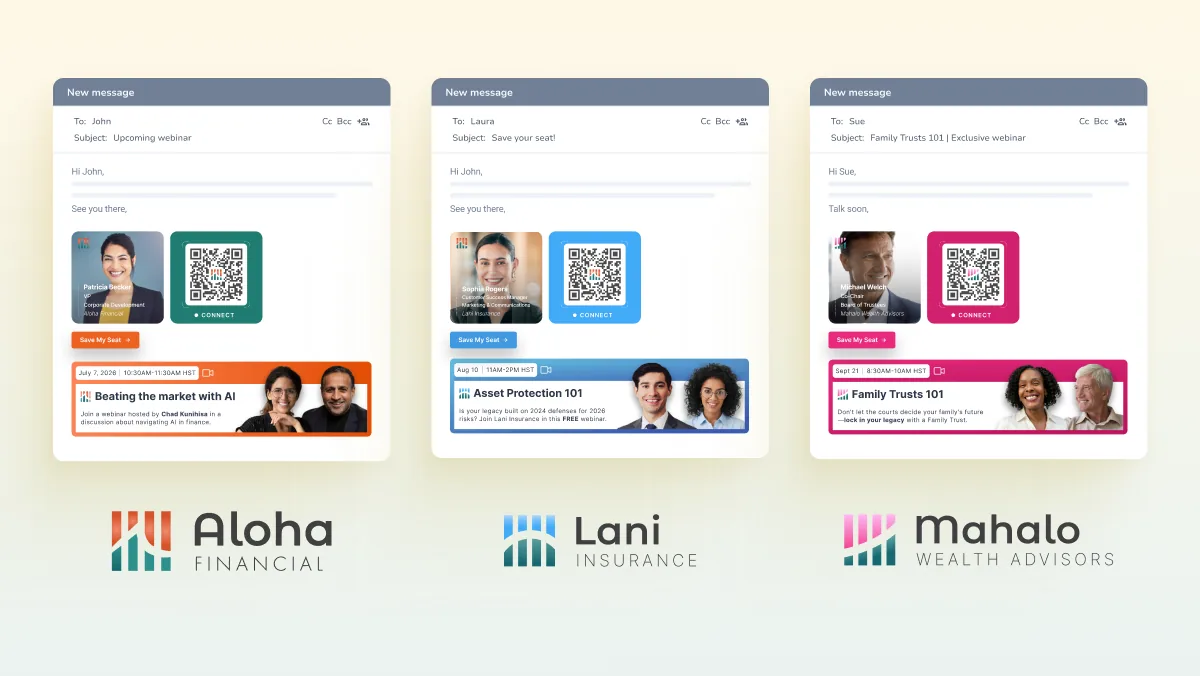
Email signatures used to be static contact information. Today they distribute webinars, product launches, hiring campaigns, customer stories, and active marketing campaigns, riding along on communication employees are already sending every day. This is email signature marketing: turning routine outbound email into owned media that marketing controls.

The math is hard to ignore. One HiHello customer with 1,500 deployed signatures generated more than 1.5 million email signature impressions in 50 days: no additional ad spend, no new audience to build. The effective CPM on that channel is a fraction of what marketing pays for search or LinkedIn ads, on inventory marketing already owns. The full breakdown is in our blog: how HiHello captured reach with zero ad spend.
Without centralized management, that reach fragments fast: outdated banners, inconsistent branding, conflicting campaigns, and one-off updates scattered across employees. Marketing loses control of its own brand inside the channel that runs through every department.
HiHello Email Signature Manager gives marketing teams a single source of truth for signatures across Microsoft 365 and Google Workspace. One platform. One brand standard. Marketing owns it, without filing IT tickets.
How HiHello tracks email signature impressions and clicks
Email Signature Manager Analytics captures two metrics.
Impressions are counted client-side when someone opens an email and the images in the signature load. HiHello does not route, access, or read the content of your emails. There is no third-party server sitting between your organization and your communications.
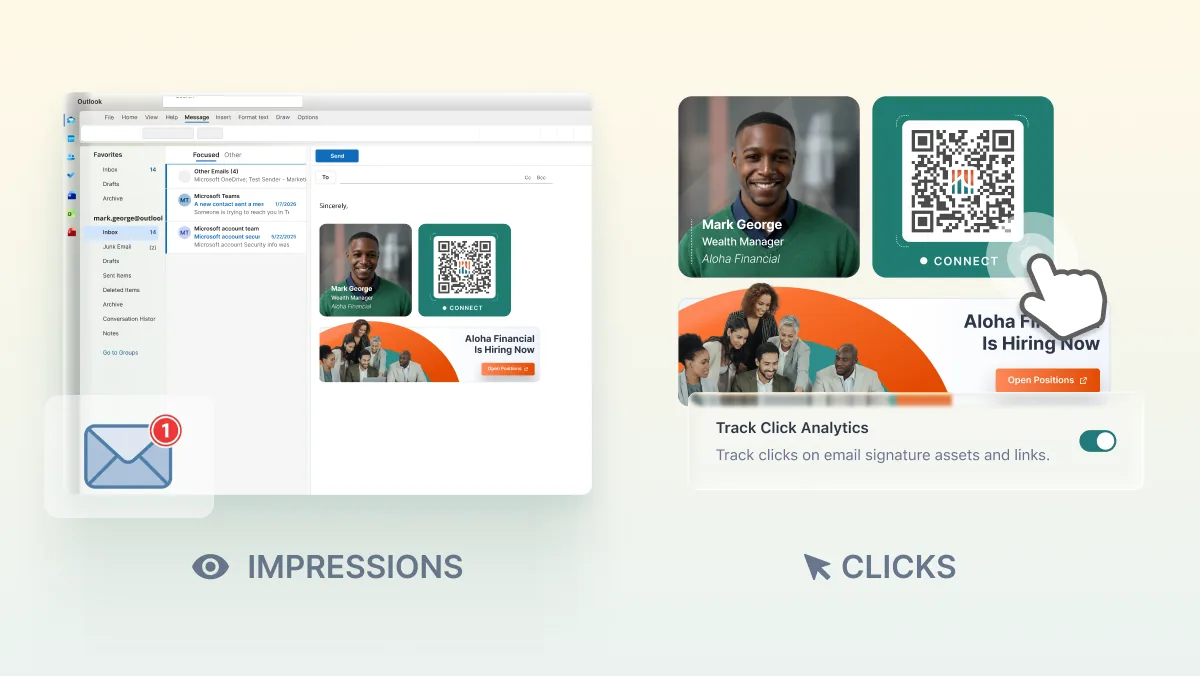
Clicks are tracked when you turn them on in HiHello. When enabled, signature links are wrapped with a redirect that records each click before sending visitors to the intended page. Some organizations want that everywhere. Others have stricter privacy requirements and don’t want any tracking. That's your call to make, not ours, so it stays off until you enable it. Once enabled, clicks on banners and CTAs are attributed to the right asset, signature, and user.
The result is per-asset, per-signature, per-user visibility, broken down the way a marketing team actually evaluates a channel.
What you can finally measure (and prove to leadership)
With email signature analytics in place, you can answer the questions that have been unanswerable:
Reach.
- How many brand impressions does employee email generate in a quarter?
- Which teams, regions, or departments generate the most?
Efficiency.
- How does signature impression volume compare to paid display or LinkedIn on a CPM basis?
- How does this reach contribute to owned-channel share of voice?
Engagement.
- Which banners and CTAs perform, and which quietly do nothing?
Those three answer what the channel delivers. The fourth question is what it's worth, and that one runs through your own systems.
Signature links can carry UTM parameters like any other campaign link. Tag them, and traffic from employee email shows up in your analytics platform and your CRM alongside every other source: sessions, conversions, and the paths people take after they arrive. Marketing gets reach and engagement from Email Signature Manager Analytics, and conversion behavior from the stack it already runs. Signature-driven campaigns stop being an untracked source and become a channel in the attribution model.
For RevOps, that means no new dashboard and no new admin burden. Signature traffic lands in the same channel-attribution view already used for paid, organic, and ABM, tagged the way every other campaign is tagged. For marketing, it becomes a defensible line item the next time the CFO asks where the budget went.

How HiHello compares to other email signature analytics approaches
Most signature platforms report the same core metrics: impressions, clicks, and performance by asset and by user. On what gets reported, the category is close to parity.
The difference is how the number is produced and how it’s shown.
Legacy signature providers apply signatures server-side. Every outbound email your company sends is routed through the vendor's infrastructure, where the signature is attached and the data is captured, before it reaches the recipient. HiHello applies signatures natively inside Microsoft 365 and Google Workspace, and counts an impression when the signature renders in the recipient's inbox. Nothing is routed. Nothing is read.
That distinction shows up in two places that matter.
The first is security review. A routed platform puts a third-party system in the path of every outbound email your company sends. That's another vendor in the data map and another system in scope every time your security team re-reviews the stack. With HiHello, the review covers the email environment you already run.
The second is ownership. A platform that lives in the mail flow is administered by the team that owns the mail flow, which is IT. HiHello is administered by marketing, so the team accountable for the channel is the team that runs it.
Organizations evaluating the security implications of their signature platform can also review what IT teams need to know about email signature risk.
Email signature analytics as part of brand governance
Email signature analytics isn't a standalone reporting tool. It's part of how enterprise marketing teams maintain brand governance at scale: the operational practice of keeping every employee touchpoint aligned with current brand standards as the organization changes.
A rebrand. A new product launch. A merger. A seasonal hiring push. Each is a moment where every employee email signature needs to update at once. Without centralized management, those moments produce inconsistency across thousands of employees. Without analytics, marketing has no way to prove the rollout actually worked.
Email Signature Manager and Email Signature Manager Analytics close both halves of that loop. Marketing controls the message. Analytics proves it landed.
Every employee email already creates a brand impression. Until now, those impressions weren't on the dashboard.
Email Signature Manager Analytics puts them there, alongside paid, organic, and every other channel marketing is already accountable for.
Talk to our team about Email Signature Manager Analytics →
Frequently asked questions
What is email signature analytics?
Email signature analytics measures the visibility and engagement generated by employee email signatures. It captures impressions (how often signatures render in recipients' emails), clicks (when configured), and per-asset performance across signatures, banners, campaigns, users, and teams.
What's the difference between email signature marketing and email signature analytics?
Email signature marketing is the practice of using employee signatures as an owned media channel to distribute campaigns, launches, and hiring pushes. Email signature analytics is the measurement layer that proves what that channel delivered: reach, engagement, and attribution. You run the marketing; the analytics tell you it worked.
What's the difference between impressions and clicks in email signature analytics?
Impressions count every time a signature is rendered in a recipient's email, a measure of reach. Clicks count every time someone interacts with a banner or CTA inside a signature, a measure of engagement. HiHello tracks impressions by default and offers click tracking as an opt-in feature.
Does HiHello read the content of our emails?
No. HiHello tracks impressions client-side, when the signature renders in the recipient's inbox. HiHello does not route, access, or read the content of your emails. There is no third-party server sitting between your organization and your communications.
How is HiHello's tracking different from other email signature analytics platforms?
Most email signature platforms route emails through their own infrastructure to apply signatures and capture analytics. HiHello applies signatures and tracks impressions inside your existing email environment (Microsoft 365 and Google Workspace), without routing email through a third party. Your emails stay inside your infrastructure, and marketing owns the data without depending on IT to extract it.
Is click tracking GDPR compliant?
HiHello's click tracking is optional and configurable based on each organization's compliance and privacy requirements. HiHello is SOC 2 Type II certified and registered under the EU-US Data Privacy Framework, UK Extension, and Swiss-US Data Privacy Framework.
Can I track performance by department, team, or campaign?
Yes. Email Signature Manager Analytics breaks performance down by signature, banner, campaign, user, team, and time period, so marketing leaders can see which messages and which groups generate the most brand visibility.
How do I prove email signature ROI to leadership?
Compare signature impressions and clicks against the CPM and CPC of the paid channels you already report on. With 1,500 signatures generating 1.5 million impressions in 50 days for one company, the effective CPM is a fraction of paid display or LinkedIn: measurable, attributable, and defensible to a CFO.
Can I export analytics data into our existing reporting?
Email Signature Manager Analytics is built for marketing teams that already report through dashboards and BI tools. Data exports are available for organizations that need to integrate signature performance into broader channel attribution.