Your company made an impression today. Thousands of them, in fact. Every email a rep sent, every video call your team joined, every introduction someone made at a conference. Each one carried your brand into a room you weren't in.
You didn't see most of them. And almost certainly, no one managed them.
The presence layer is real, and it's running unmanaged
There is a layer of your business that operates entirely through your people. It is how your company shows up in the moments that don't run through a campaign or a landing page. The signature under a sales email. The card shared at a booth. The face on a Tuesday-afternoon Zoom. The reply a support rep sends at 6 p.m.
Marketing spends months on the brand that lives on the website and in the ad account. Then it hands the rest to hundreds of individual people and hopes for the best. The logo is perfect on the homepage and three versions old on half your team's signatures. The messaging is airtight in the campaign and improvised in the field.
This is not a small surface. It is most of the surface. A company of any real size shows up in the world far more often through its people than through anything the marketing team ships directly. Those moments are the brand, whether or not anyone is treating them that way.

You modernized everything except this
Walk through what the last few years actually looked like inside most companies. The CRM got replaced. The finance stack got rebuilt. HR moved to a system that talks to the directory. The data team stood up infrastructure that would have been science fiction a decade ago. Real money, real focus, real transformation.
And through all of it, the way your people present your company stayed exactly where it was. Signatures set by hand, one person at a time. Cards ordered from a vendor marketing stopped using. Backgrounds left to whatever each person happened to pick (or not pick). No system, no way to hold your standard, no data on any of it.
The asymmetry is the tell. The back office got modern. The part of the business your customers actually see and touch, the part that carries the brand into every conversation, got left on manual. It is the one layer that never made it onto the transformation roadmap, and it happens to be the one buyers experience most.

Scattered parts can't be held, and they can't be measured
When something runs as a hundred separate pieces instead of one system, two things follow, and both are expensive.
The first is that you can't hold it. Change the logo, and you get caught chasing thousands of people to update thousands of touchpoints, for months, with the old brand and the new one both live in the market the entire time. Consistency becomes a plea instead of a property of the system. Anyone who has tried to hold a brand consistent across thousands of people knows the version of this where you are still finding the old logo years later (unfortunately, a true story).
The second is that you can't measure it. Every other channel reports. Paid reports. Email reports. Events, eventually, report. But the presence layer produces no numbers at all, so it sits outside every conversation about what marketing drove. You are running what may be your largest surface area completely dark, which means you can neither prove its value nor improve it. The interactions already driving your pipeline are, for most companies, the ones that no one is watching.
A thing you can't hold and can't measure isn't a channel. It's a liability waiting to turn into a problem.
The shift is to treat presence as one system
The fix is not more effort inside the old model. You can’t chase your way to consistency, and you can’t spreadsheet your way to measurement. The fix is a change in category: stop treating professional presence as a pile of individual artifacts and start running it as a single system.
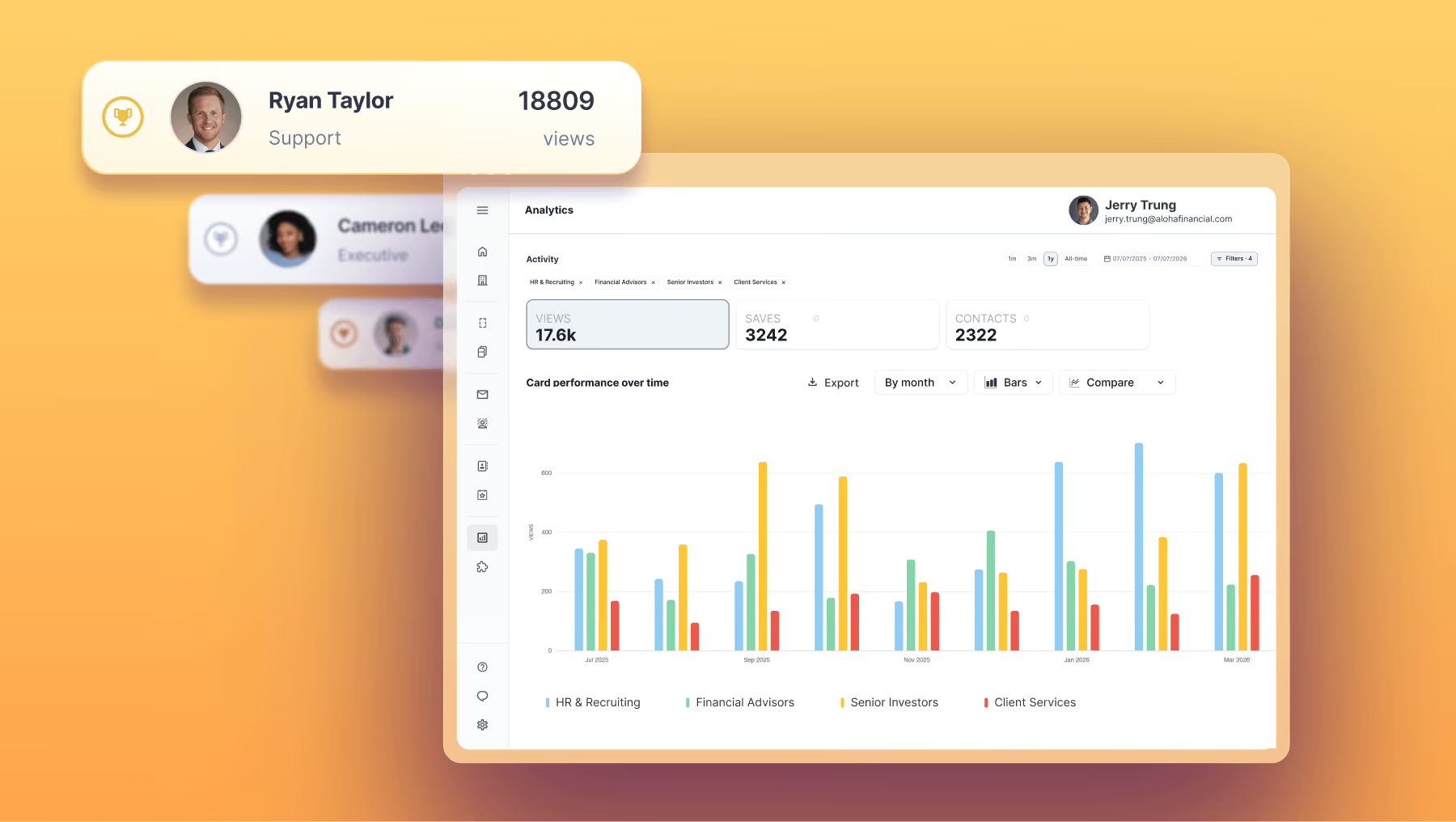
One system means the standard is set once and holds everywhere, so a brand change is a single update instead of a manhunt. It means presence connects to the tools you already run, so it moves when the company moves instead of lagging a rebrand or merger by six months. And it means the layer finally produces numbers, so it shows up in the same reports as everything else you manage.
That is the difference between a documented brand and an operational one. Guidelines describe what should happen. A system makes it happen at scale, without asking every employee to be the enforcement mechanism.
This is the category we built HiHello to define: the professional presence platform, the system that runs how a whole company shows up as one connected thing rather than thousands of unmanaged parts. Across 64M+ cards shared, 3.8B+ emails sent with HiHello signatures, and people at more than 90% of the Fortune 500, the pattern is the same. The companies that treat presence as a system stop losing the brand in the gaps, and start seeing a surface they used to run blind.
Where to go from here
If your company is in the middle of changing something, a rebrand, an acquisition, a tech stack consolidation, the presence layer is where that change either lands or quietly fails to. See how to modernize how your company shows up so the brand your team represents on the first Monday after launch is the one you actually announced.
Frequently Asked Questions
What is a professional presence platform?
A professional presence platform is the system a company uses to manage how it shows up across every employee touchpoint, digital business cards, email signatures, and video call backgrounds, from one place instead of leaving each person to manage their own. It treats professional presence as a single, governable channel rather than thousands of individual artifacts. The distinction matters because presence is one of the largest surfaces a company has and, in most organizations, the only one with no owner and no data.
Why treat professional presence as a system instead of individual touchpoints?
Because individual touchpoints can't be held consistent or measured, and the presence layer is too large to run any other way. When every employee manages their own card and signature, a brand change becomes a months-long chase, the old and new brand run side by side the whole time, and no one has visibility into the state of the brand across the company. Running presence as one system means the standard is set once and holds everywhere, and the layer finally reports like every other channel marketing manages.
How is a company's professional presence different from its brand guidelines?
Brand guidelines describe what should happen; a professional presence system makes it happen. A guideline document sits in a shared drive and depends on thousands of people reading it, remembering it, and applying it correctly every time. A system embeds the standard into the touchpoints themselves, so the brand people carry into the world is the current one by default, not by diligence. The gap between the two is where brand drift lives.